--BFS + maze path of the recording (POJ-3984)
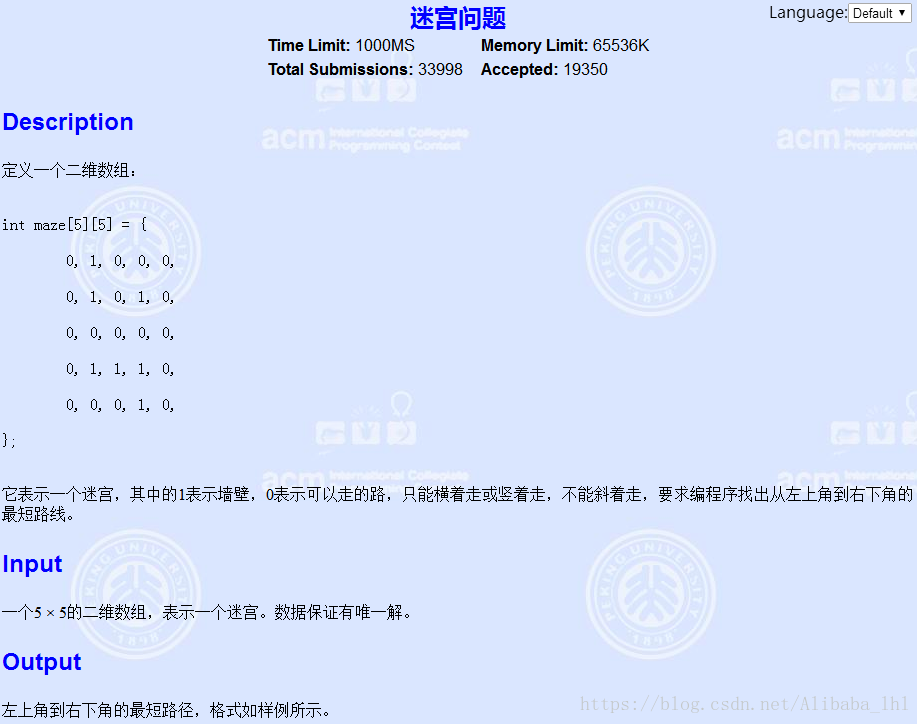
The definition of a two-dimensional array:
int maze[5][5] = {
0, 1, 0, 0, 0,

0, 1, 0, 1, 0,

0, 0, 0, 0, 0,

0, 1, 1, 1, 0,

0, 0, 0, 1, 0,
};
It represents a labyrinth, in which 1 represents the wall, 0 way to go, can only go sideways or vertically to go, can not go sideways, requiring programmed to find the shortest route from the top left to the bottom right corner.
Input
A 5 × 5 two-dimensional array, showing a maze. Ensure data has a unique solution.
Output
Left to bottom right shortest path, the format as shown in the sample.
Sample Input
0 1 0 0 0
0 1 0 1 0
0 0 0 0 0
0 1 1 1 0
0 0 0 1 0
Sample Output
(0, 0)
(1, 0)
(2, 0)
(2, 1)
(2, 2)
(2, 3)
(2, 4)
(3, 4)
(4, 4)
Thinking
Find the path is very simple, basic bfs subject, but also to the path of the recording of this question, the method used here thinking and focused search and similar parent array, also used a Root parent node record for each array point, then, when the output of the direct recursion reverse output on the vans.
#include<iostream>
#include<string>
#include<cstring>
#include<cstdio>
#include<cmath>
#include<vector>
#include<map>
#include<queue>
#include<stack>
#include<algorithm>
using namespace std;
int _map[5][5];
bool vis[5][5];
int dic[4][2]={{-1,0},{1,0},{0,-1},{0,1}};
struct point
{
    int x,y,root;
};
point ans[25];
bool judge(int _x,int _y)
{
    return _x>=0&&_x<5&&_y>=0&&_y<5;
}
void print(point p)
{
    while(p.root!=-1)
    {
        print(ans[p.root]);
        cout<<"("<<p.x<<", "<<p.y<<")\n";
        return;
    }
    cout<<"(0, 0)\n";
}
void bfs(int x,int y)
{
    point p;
    p.x=x;
    p.y=y;
    queue<point> num;
    num.push(p);
    int cnt=0,k=0;
    p.root=-1;
    ans[0]=p;
    cnt++;
    while(!num.empty())
    {
        point q=num.front();
        num.pop();
        if(p.x==4&&p.y==4)
        {
            print(p);
            return;
        }
        for(int i=0; i<4; i++)
        {
            int _x=q.x+dic[i][0];
            int _y=q.y+dic[i][1];
            if(!vis[_x][_y]&&!_map[_x][_y]&&judge(_x,_y))
            {
                vis[_x][_y]=true;
                p.x=_x,p.y=_y;
                p.root=k;
                num.push(p);
                ans[cnt++]=p;
            }
        }
        k++;
    }
}
int main()
{
    for(int i=0; i<5; i++)
        for(int j=0; j<5; j++)
            vis[i][j]=false;
    for(int i=0; i<5; i++)
        for(int j=0; j<5; j++)
            cin>>_map[i][j];
    bfs(0,0);
}
Intelligent Recommendation
POJ 3984 record path maze BFS +
Maze Time Limit: 1000MS Memory Limit: 65536K Total Submissions: 15775 Accepted: 9389 Description The definition of a two-dimensional array: which represents a labyrinth, where 1 represen...
POJ 3984: bfs + recursive output path Maze
Maze Time Limit: 1000MS Memory Limit: 65536K Total Submissions: 11844 Accepted: 7094 Description defines a two-dimensional array: which represents a labyrinth, where ...
poj 3984 maze (bfs print path)
http://poj.org/problem?id=3984 Ideas: the most basic bfs Recording the coordinates of the parent node and the final print path stl queue: Handwriting queue: ...
POJ 3984 maze (bfs + shortest path print)
Topic: POJ3984, find the shortest path from the starting point to the upper left and lower right end print...
Poj 3984 maze, BFS, the path back: [explanations]
Maze Time Limit: 1000MS Memory Limit: 65536K Description The definition of a two-dimensional array: int maze[5][5] = { }; It represents a labyrinth, in which 1 represents the wall, 0 way to go, can on...
More Recommendation
POJ - 3984 - maze print path] [BFS +
answer: With a two-dimensional array structure to save the coordinates of each point on a point by recursively reach the starting point when printing path backtracking ...
Maze POJ - 3984 (BFS memory path)
A node with a node pre [x] [y] recording pre [x] [y] by a recursive thereby reverse printing result....
POJ 3984-Maze problem (bfs + path save)
Maze problem Time Limit: 1000MS Memory Limit: 65536K Total Submissions: 31780 Accepted: 18180 Description Define a two-dimensional array: It represents a maze, where 1 represents the wal...
POJ-3984-Maze problem (bfs + record path)
Sample Input Sample Output Ideas Use a path array to store the labels that can be reached in each step for recursive output path. For example, the path array data in the sample is (below). You can cle...

POJ-3984 Maze problem (bfs+path output)
K-The maze problem (POJ - 3984) Ideas: bfs+ path output, there are many ways to record the path....