Analysis of libpcap packet capture under linux
First, download the libpcap package first.http://www.tcpdump.org/#latest-release
Then install, after the installation is complete, go to the tests folder of the installation root directory, compile and run findalldevstest.c (compile with -lpcap) to see if all network devices are found.
Second, download wireshark to observe the various functions of the capture software
Third, familiar with the working principle of libpcap:
Fourth, understand the basic process of libpcap capture:
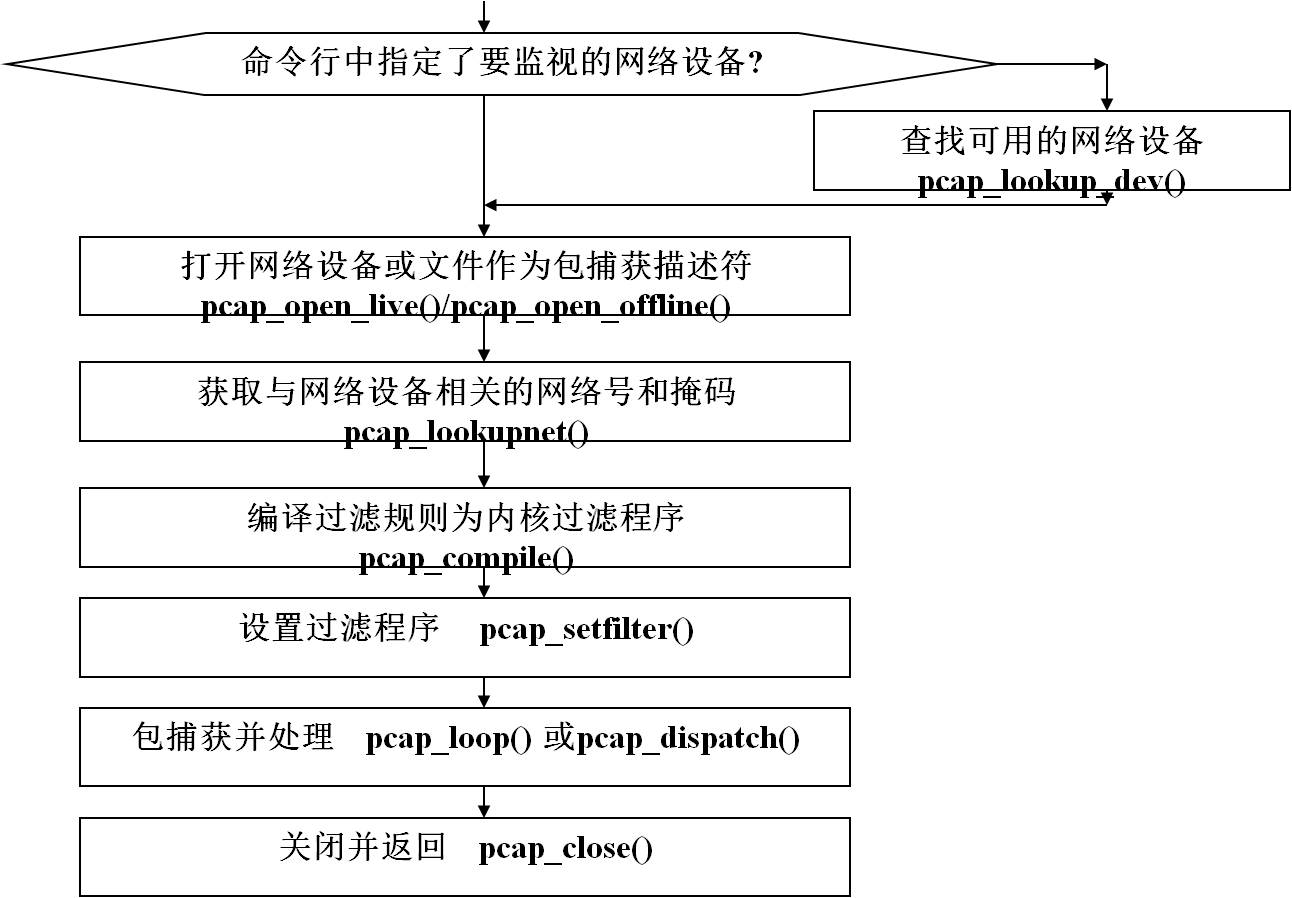
Five, programming implementation
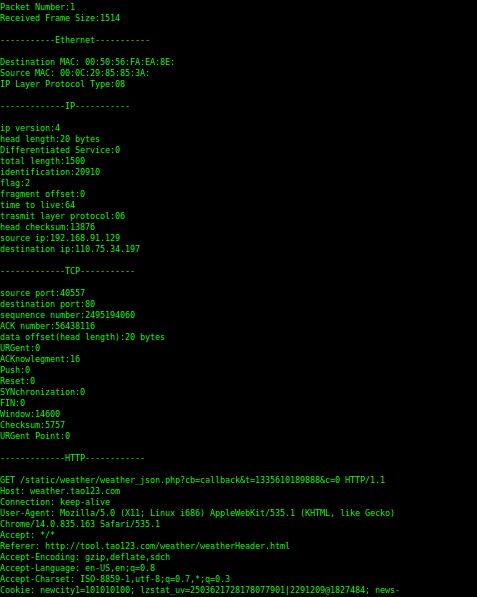
To be continued. . .
PS: Organize the data type definitions commonly used by libpcap
- Type definition of libpcap:
0)、typedef int bpf_int32
1)、typedef u_int bpf_u_int32
32bit typeless shaping;
2)、typedef pcap pcap_t
Descriptor of an open capture instance (an open capture instance descriptor?) This structure is opaque to the user.
3)、typedef pcap_dumper pcap_dumper_t
Libpcap saves the descriptor of the file.
4)、typedef pcap_if pcap_if_t
An element of a network card list;
5)、typedef pcap_addr pcap_addr_t
a representation of the network card address;
6)、typedef void (*pcap_handler)(u_char *args, const struct pcap_pkthdr *header, const u_char *packet);
Where agrs is the fourth parameter passed from the pcap_dispatch() function. Generally, our own package capture program does not need to provide it, it is always NULL; header points
Pcap_pkthdr structure, which is located in front of the real physical frame to eliminate differences in support of different link layers; packet points to the physical frame of the captured message.
- Libpcap structure
The data structure definitions necessary for Libpcap library functions are mainly contained in the two header files pcap.h and pcap-int.h.
1) The pcap structure is defined in the pcap-int.h header file:
The members that need to be involved in programming are: int fd; open the device descriptor; u_char *buffer; is the buffer pointer to the captured data
struct pcap
{
Int fd; /* file description word, actually socket * /
Int selectable_fd; /* On sockets, I/O reuse type functions such as select() and poll() can be used */
Int snapshot; /* The maximum length of the capture packet expected by the user */
Int linktype; /* device type */
Int tzoff; /* time zone location, not actually used */
Int offset; /* boundary alignment offset */
Int break_loop; /* Forces a flag to jump out of the read packet loop */
Struct pcap_sf sf; /* The relevant configuration data structure for saving the data packet to the file */
Struct pcap_md md; /* is described as follows */
Int bufsize; /* length of the read buffer */
U_char buffer; /* read buffer pointer */
u_char *bp;
int cc;
u_char *pkt;
/* Function pointers for related abstract operations, which ultimately point to handlers for specific operating systems */
int (*read_op)(pcap_t *, int cnt, pcap_handler, u_char *);
int (*setfilter_op)(pcap_t *, struct bpf_program *);
int (*set_datalink_op)(pcap_t *, int);
int (*getnonblock_op)(pcap_t *, char *);
int (*setnonblock_op)(pcap_t *, int, char *);
int (*stats_op)(pcap_t *, struct pcap_stat *);
void (*close_op)(pcap_t *);
/* If the BPF filter code cannot be executed in the kernel, save it and execute it in user space */
struct bpf_program fcode;
/* function call error message buffer */
char errbuf[PCAP_ERRBUF_SIZE + 1];
/* Number of data link types supported by the current device */
int dlt_count;
/* The data link type number list that can be changed is not used under linux */
int *dlt_list;
/* Packet custom header, description of packet capture time, capture length, real length [pcap.h] */
struct pcap_pkthdr pcap_header;
};
/* Contains the interface, state, and filter information for the capture handle [pcap-int.h] */
struct pcap_md {
/* Capture state structure [pcap.h] */
struct pcap_stat stat;
Int use_bpf; /* If 1, it means using kernel filtering*/
u_long TotPkts;
U_long TotAccepted; /* Number of received packets */
U_long TotDrops; /* Number of dropped packets */
Long TotMissed; /* Number of packets dropped by the interface while filtering is in progress */
Long OrigMissed; /*Number of packets discarded by the interface before filtering is performed*/
#ifdef linux
Int sock_packet; /* If 1, it means SOCK_PACKET mode using 2.0 kernel */
Int timeout; /* pcap_open_live() function timeout return time */
Int clear_promisc; /* Set the interface to non-promiscuous mode when closed */
Int cooked; /* Use SOCK_DGRAM type */
Int lo_ifindex; /* loop device index number */
Char *device; /* interface device name */
/* Open the pcap_t list of sockets of type SOCK_PACKET in promiscuous mode*/
struct pcap *next;
#endif
};
(2) bpf_program structure
This structure is used in the pcap_compile() function and is defined in the bpf.h header file.
/* [pcap-bpf.h] */
struct bpf_program {
U_int bf_len; /* Number of predicate instructions in BPF code */
Struct bpf_insn *bf_insns; /* first predicate judgment instruction */
};
/* Predicate judgment instruction structure */
struct bpf_insn {
u_short code;
u_char jt;
u_char jf;
bpf_int32 k;
};
(3)
/usr/include/net/bpf.h
/*
* Structure prepended to each packet.
*/
Each time the kernel filter outputs a packet, 20 bytes of data will be added before the output data. This is struct bpf_hdr
struct bpf_hdr
{
struct timeval bh_tstamp; /* time stamp */
Bpf_u_int32 bh_caplen; /* length of captured portion data length*/
Bpf_u_int32 bh_datalen; /* original length of packet actual package length */
u_short bh_hdrlen; /* length of bpf header (this struct
plus alignment padding) */
};
(4) pcap_stat structure
Calling the function pcap_stats() can return a structure
struct pcap_stat {
u_int ps_recv; /* number of packets received */
u_int ps_drop; /* number of packets dropped */
u_int ps_ifdrop; /* drops by interface XXX not yet supported */
};
5)、
Struct pcap_addr: NIC address description
{
Pcap_addr *next; if not empty, a pointer to an element in the linked list; empty means the last element in the linked list
Sockaddr *addr; pointer to the structure of the sockaddr containing an address
Sockaddr *netmask; if non-empty, points to a structure containing a netmask relative to the address pointed to by addr
Sockaddr *broadaddr; if not null, points to a structure containing a netmask relative to the address pointed to by addr
Sockaddr *dstaddr; If non-empty, points to a destination address relative to the source address pointed to by addr, or null if the network does not support peer-to-peer communication
};
6), dump file format
The first is the Dump file header.
struct pcap_file_header {
bpf_u_int32 magic;
u_short version_major;
u_short version_minor;
bpf_int32 thiszone; /* gmt to local correction */
bpf_u_int32 sigfigs; /* accuracy of timestamps */
bpf_u_int32 snaplen; /* max length saved portion of each pkt */
bpf_u_int32 linktype; /* data link type (LINKTYPE_*) */
};
Then the header and data for each package
Pcap_pkthdr structure
/usr/include/pcap.h
/*
* Each packet in the dump file is prepended with this generic header.
* This gets around the problem of different headers for different
* packet interfaces.
*/
/* The custom header is also used to save the packet to a file */
struct pcap_pkthdr
{
Struct timeval ts; /* capture timestamp */
Bpf_u_int32 caplen; /* Capture the length of the packet */
Bpf_u_int32 len; /* The true length of the packet */
}
/* Single packet structure containing packet meta information and data information */
struct singleton [pcap.c]
{
Struct pcap_pkthdr hdr; /* libpcap custom packet header */
Const u_char * pkt; /* points to the captured network data */
};
7), pcap_if (libpcap custom interface information list [pcap.h])
struct pcap_if
{
struct pcap_if *next;
Char *name; /* interface device name */
Char *description; /* interface description */
/* interface IP address, address mask, broadcast address, destination address */
struct pcap_addr addresses;
Bpf_u_int32 flags; /* interface parameters */
};
Intelligent Recommendation
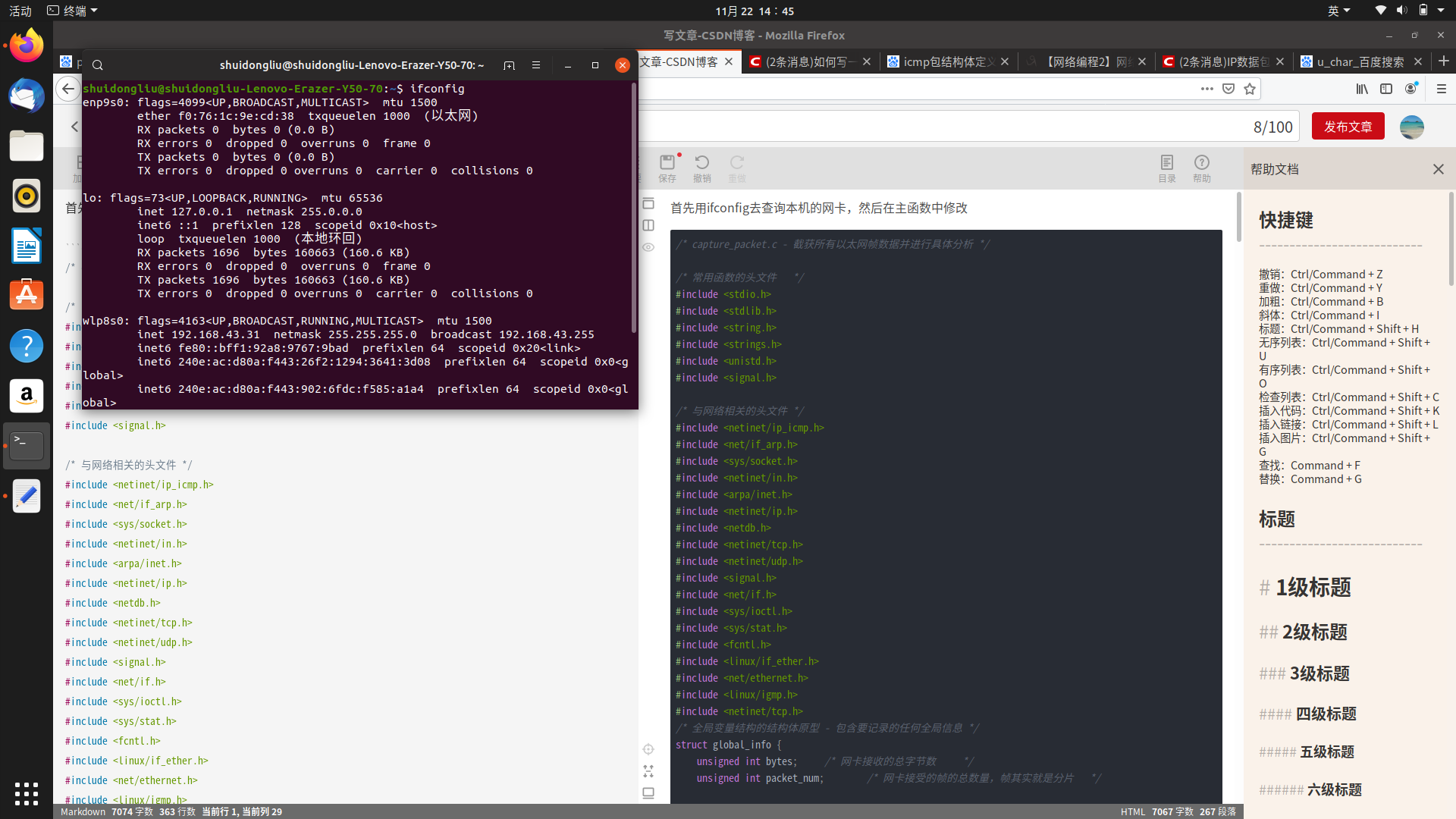
Packet capture under linux
First use ifconfig to query the network card of the machine, and then modify it in the main function The enp9s0 here is what we need...
linux packet capture and analysis
Do not specify any parameters Monitor specific network card Monitor specific host, example: 10.0.32.28, Remarks: out of the package will be monitored Communication specific source, destination address...
libpcap packet capture library multiple network adapters
Install libpcap library First, install the associated support environment Then download the latest version of libpcap, Download:http://www.tcpdump.org/。 Decompression, enter the following command in t...
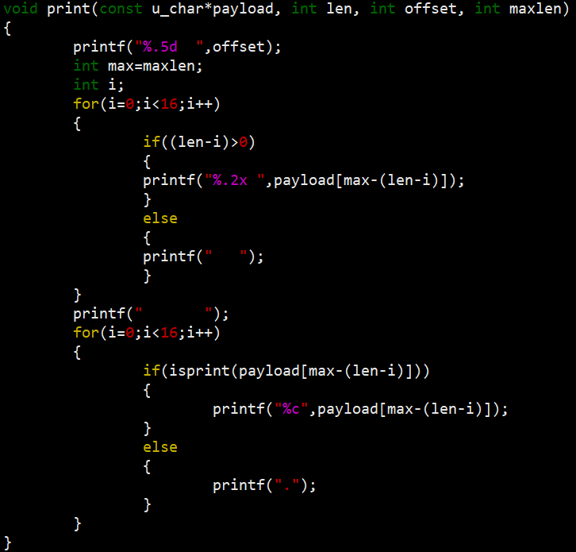
IP packet capture library use Libpcap LAN
Experimental requirements Source and destination physical address of the print data packet; Print source IP and destination IP address; Printing upper layer protocol type; If the upper layer protocol ...
More Recommendation
libpcap network packet capture function library
download Compile and install Instance The C function interface provided by the library is used to capture data packets passing through the specified network interface. download: http://www.linuxfromsc...

Linux network packet capture/packet capture technology comparison: napi, libpcap, afpacket, PF_RING, PACKET_MMAP, DPDK, XDP (eXpress Data Path)
Table of Contents 1. Traditional Linux network protocol stack process and performance analysis The main problem of the protocol stack Resource allocation and release for a single packet level Serial a...
Install Libpcap under Linux
[size=xx-large][b][color=red]I am a rookie! [/color][/b][/size] installation steps: Unzip libpcap There were no errors during the installation process. But I don't know how to know if the installation...
Design and implementation of network packet capture and traffic online analysis system-based on libpcap on MacOS Record this happy (DT) week
Design and implementation of network packet capture and traffic online analysis system-based on libpcap on MacOS Record this happy (DT) week Claim: Design and implement a network flow analysis system ...

linux-speed packet capture technology comparison --napi / libpcap / afpacket / pfring / dpdk
1. Traditional process linux stack performance and network protocol analyzer Linux network protocol stack processing system is a typical network data packet, which contains the whole process from the ...