Electronic Design Tutorial 50: 16*16 LED Dot Matrix Screen Driver-LED Dot Matrix Screen Working Principle
tags: Electronic design
I tried to cascade the shift register + 38 decoder to achieve 3 control lines and drive 16The effect of 16LED dot matrix screen. This is the second blog about the working principle of LED dot matrix screen.
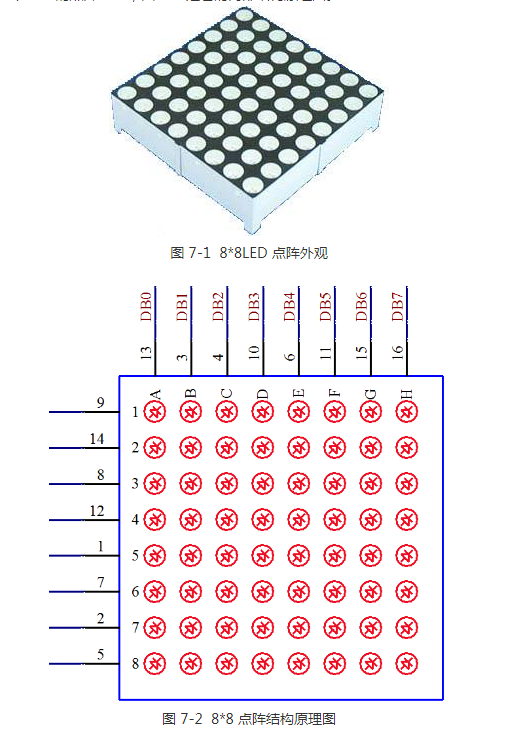
8 in the figure below8LED dot matrix screen, if you want to control the LED lights in the second row and third column (referred to as LED(2,3)) to light up, you can make pin V7 output high level and G3 output low level. If you want to control LED (2,3) and LED (4,3) to light up at the same time, you can make V7 and V5 output high level, G3 output low level.
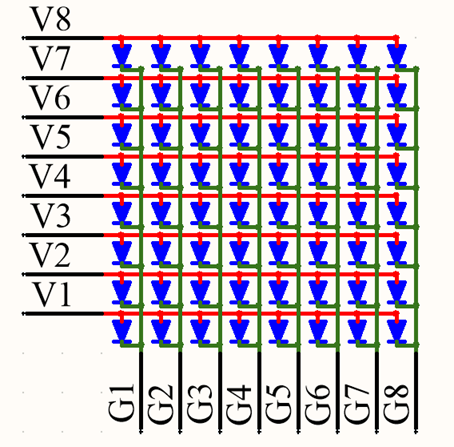
In this way, only 1 column or 1 row of LEDs can be lit at a time. We can call it progressive scan or column by column scan. If you want to light up multiple columns of LEDs at once, the status of the LEDs in the same row is different, which will make the control of the level of this row into contradiction. If LED(1,1) and LED(2,2) need to be bright, but LED(1,2) is not bright, then should V8 output high level or low level?
Line-by-line scanning or column-by-column scanning uses the principle of persistence of vision. When the human eye observes a scene, the light signal is transmitted to the brain nerves. It takes a short period of time. After the action of light ends, the visual image does not disappear immediately. This phenomenon of vision is called "persistence of vision". First let V8 be high and G1 be low, and turn on the LED (1,1). Then quickly make V8 low and G2 low, turn off the LED (1,2), and at the same time, turn V7 to high to light up the LED (2,2). As long as the switching speed is fast enough, wait until each column is cycled once, and when it is the G1 column again, the LED (1,1) is re-lit, but your eyes still do not react, then you will think that the LED ( 1,1) Never extinguished. The key point is that the refresh speed should be fast.
It is not difficult to understand. To drive an 8×8 LED dot matrix, a total of 16 control lines in 8 rows and 8 columns and 2 74HC595 chips are required. We connect V1-V8 to the parallel output pins QA-QH of U1 of the 74HC595 chip, and connect G1-G8 to QA-QH of U2. Of course, the reverse is also possible. U1 and U2 are cascaded, U1's SER is connected to the serial data input of the control chip, and U1's QH' is connected to U2's SER. The output enable of U1 and U2 is connected to low level (can be output), and reset is connected to high level (not reset). In this way, only the shift register clock input, the storage register clock input, and the data serial input are required to drive the LED dot matrix screen.
Intelligent Recommendation

UC1617 dot matrix screen driver
The UC1617 is a monochrome dot matrix LCD driver chip that supports up to 128*128 resolution. Chip Handbook: The first thing to note is that this driver chip is a bit different from other monoc...
51-LED dot matrix
Lighting principle Column selection: Active high. Row selection: active low. Lights up if a point is selected and selected at the same time. 8*8 dot matrix Decimal x is converted to binary y, say 5-&g...
SCM LED dot matrix
SCM LED dot matrix 1. Brief description Use 8×8LED dot matrix to display Chinese characters. Scroll up the "Chinese" two Chinese characters. File packaging: Link: https://pan.baidu.com...

LED dot matrix
1 Introduction to LED dot matrix 1.1 What is LED dot matrix (1) Appearance. (2) Role. (3) Schematic diagram of internal structure. The advantage of dot matrix is that 8+8 IO ports independently cont...
More Recommendation
LED dot matrix display
Text modeling software:...
LED dot matrix - 2
Previously writtenLED dot matrix display - 1In the middle, I tried to analyze the connection between code and hardware, in fact, this kind of unparalleled way of thinking is wrong. For engineers of a ...

Dot matrix LED display principle (turn)
Add an ad, my Taobao shop, Dot matrix LED display principle (transfer to May 24, 2007) I watched a friend do the LED screen a few days ago and wanted to see if I could do it. Find this on the Internet...
System problem and LED dot matrix
First, the hexadecimal representation: Decimal: 1,234,567,891,011,121,314 15 Hex: 1 2 3 4 5 6 7 8 9 A B C D E F Binary: 0000 0001 001 0100 0101 0101 0101 0111 01000 1001 1010 1011 1011 1100 1100 1110 ...
7.3 Introduction of LED dot matrix
As a modern electronic media, dot matrix LED display has the characteristics of flexible display area (can be divided and assembled at will), high brightness, long life, digitalization, real-time, etc...