C++ notes list use
List is a doubly linked list, header file #include<list>
1. Basic operation
insert:Headend, tailend, middle (through iterators)
Find:There is no member function, only the iterator can be returned by find(ilist.begin(), ilist.end(), 1)
delete:Headend, tailend, middle (through iterators)
Sort:Member function ilist.sort(), default ascending
reverse:Ilist.reverse(), element reversal
Empty:Ilist.empty(), if empty, returns 1; if not empty, returns 0.
Empty:ilist.clear().
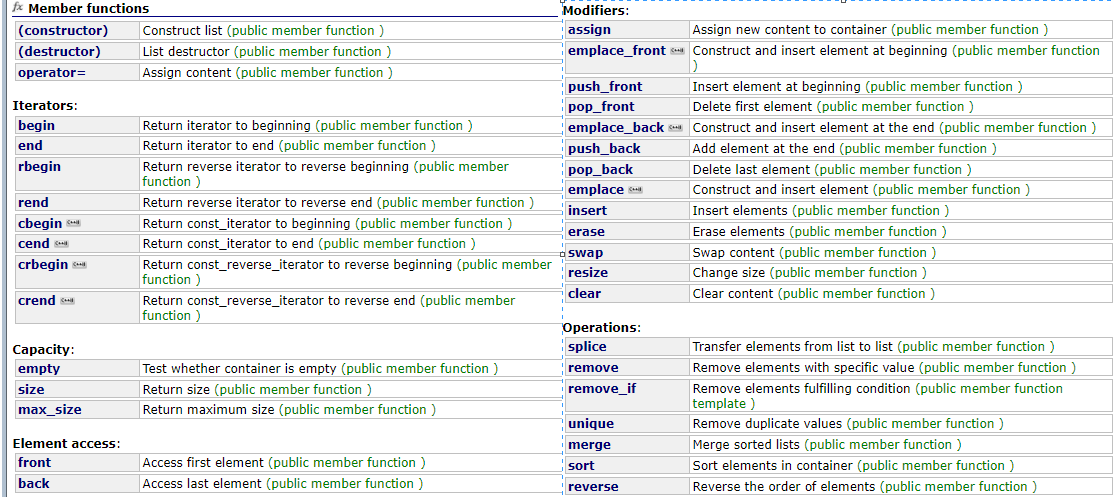
2. Function list
Ilist.assign() assigns a value to the list
Ilist.begin() returns an iterator pointing to the first element
Ilist.end() returns the end of the iterator
Ilist.rbegin() returns a reverse iterator pointing to the first element
Ilist.rend() points to the reverse iterator at the end of the list
Ilist.clear() removes all elements
Ilist.empty() returns true if the list is empty
Ilist.push_back() adds an element to the end of the list
Ilist.push_front() adds an element to the head of the list
Ilist.front() returns the first element
Ilist.pop_front() removes the first element
Ilist.back() returns the last element
Ilist.pop_back() removes the last element
Ilist.remove() removes an element from the list
Ilist.remove_if() deletes elements by specified criteria
Ilist.get_allocator() returns the configurator for list
Ilist.insert() inserts an element into the list
Ilist.max_size() returns the maximum number of elements a list can hold
Ilist.merge() merges two lists
Ilist.resize() changes the size of the list
Ilist.size() returns the number of elements in the list
Ilist.sort() sorts list
Ilist.reverse() reverses the elements of list
Ilist.splice() merges two lists
Ilist.swap() exchanges two lists
Ilist.unique() removes duplicate elements from the list
3. Program example
#include<iostream>
#include<list>
#include<algorithm>
using namespace std;

int main(){

	list<int> ilist;
	list<int>::iterator it;

	//insert
	 Ilist.push_back(1);//tail insertion
	ilist.push_back(2);
	ilist.push_back(6);
	ilist.push_back(9);
	 Ilist.push_front(3);//Head insertion
	ilist.push_front(4);
	ilist.push_front(7);
	ilist.push_front(8);
	 // lookup
	it=find(ilist.begin(),ilist.end(),1);
	 It=ilist.insert(it,5);//Intermediate insertion
	 Cout<<"it position:"<<*it<<endl;

	 //output
	 Cout<<"list size:"<<ilist.size()<<endl;
	for(it=ilist.begin();it!=ilist.end();it++) cout<<*it<<' ';
	cout<<endl<<endl;


	 //delete
	 Cout<<" delete header element: "<<ilist.front()<<endl;//return header element
	 Ilist.pop_front(); //delete header element
	 Cout<<" removes the tail element: "<<ilist.back()<<endl;//returns the tail element
	 Ilist.pop_back(); //Delete tail element
	it=find(ilist.begin(),ilist.end(),3);
	 Cout<<" deletes the middle element: "<<*it<<endl;
	 Ilist.erase(it); //delete the middle 4
	 Cout<<" delete intermediate element: 1"<<endl;
	 Ilist.remove(1); // directly delete the element

	 Cout<<" after deleting the list size: "<<ilist.size()<<endl;
	for(it=ilist.begin();it!=ilist.end();it++) cout<<*it<<' ';
	cout<<endl<<endl;

	 //sort
	 Ilist.sort();//Default ascending
	 Cout<<" default sort: ";
	for(it=ilist.begin();it!=ilist.end();it++) cout<<*it<<' ';
	cout<<endl;
	 Cout<<"reverse output:";
	 Ilist.reverse();//Element reverse
	for(it=ilist.begin();it!=ilist.end();it++) cout<<*it<<' ';
	cout<<endl<<endl;
	/*
	list<int> ilist2(ilist.rbegin(),ilist.rend());
	for(it=ilist2.begin();it!=ilist2.end();it++) cout<<*it<<' ';
	*/

	 / / Empty, empty
	 Is cout<<"list empty:"<<ilist.empty()<<endl;
	ilist.clear();
	 Is cout<<"list empty:"<<ilist.empty()<<endl;

	return 0;
}
operation result:
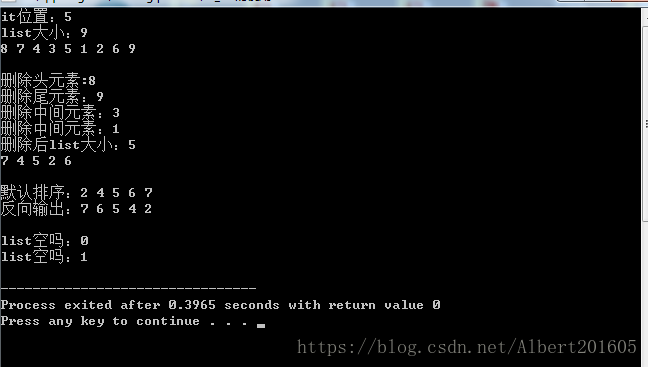
reference
Intelligent Recommendation
Use the list of C language
C language is difficult to say that the list beginner, come to you today to talk about the list Speaking before the list had to tell us about the structure, before we learn the list should have been s...
c # in use exemplary list
Reproduced in: https: //my.oschina.net/smartsmile/blog/815512...
c++ std::list use
One requirement is that there are five boxes and put the items in the smallest box FR: hunk Xu QQ technical exchange group: 386476712...
[C++] Introduction and use of list
The following is Ali’s summary of the list container. I hope it will be helpful to everyone. If there is any mistake, please point out 1: Introduction to list 2: Use of list 1: Introduction to l...
More Recommendation
The creation and use of List in C#
Collection class List When we have many data of the same type, we can use arrays for storage and management, but the disadvantage of this is that the size of the array is predetermined and fixed. If w...
C# List use pitfalls
Basic knowledge is not solid, use List<T>, unexpected results appear It should output as expected: 2 3 4 5 The actual result is: 5 5 5 5 It turns out that my basic knowledge is not solid enough ...
(C#) List use
The basics and common methods of List: Common function calls in List A. Add elements: B. Insert element: Insert(int index, T item); Add an element at the index position c. delete ...
[C++] How to use list
List is a serial container. The function performed by the list container is actually very similar to the doubly linked list in the data structure. The data elements in the list are connected to a line...
Use of C# List
The creation and use of List Create a list (a list can store any type of data. When creating a list object, you must first specify what type of list you want to create) (generic) Insert data Read data...