Use join for thread synchronization in python
tags: python notes Multithreading python
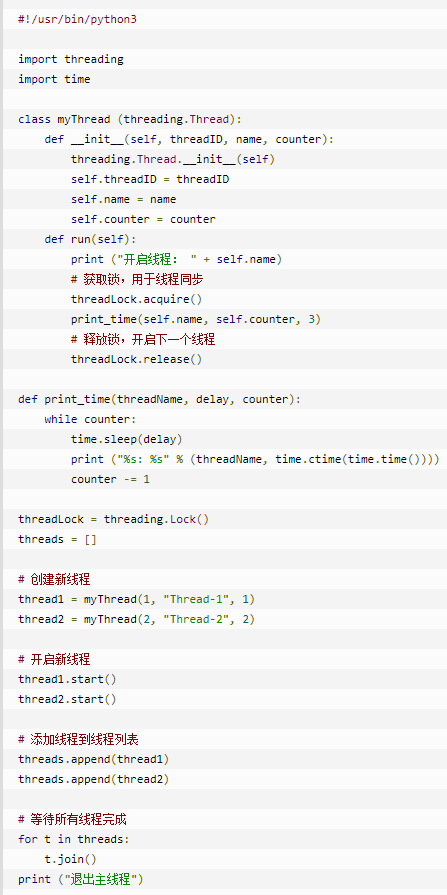
import threading
import time

lock = threading.Lock()
threads = []


class MyThread(threading.Thread):
	def __init__(self, threadID, name, counter):
		threading.Thread.__init__(self)
		self.threadID = threadID
		self.name = name
		self.counter = counter

	def run(self):
		print("Start thread" + self.name)

		lock.acquire()
		# Open lock

		print_time(self.name, self.counter, 3)
		# Release the lock
		lock.release()


def print_time(ThreadName, delay, counter):
	while counter:
		time.sleep(delay)
		print("%s : %s " % (ThreadName, time.ctime(time.time())))
		counter -= 1

def _main():
	# Create thread
	thread1 = MyThread(1, "Thread-1", 1)
	thread2 = MyThread(2, "Thread-2", 2)
	thread1.start()
	thread2.start()
	print('Exit the main thread')
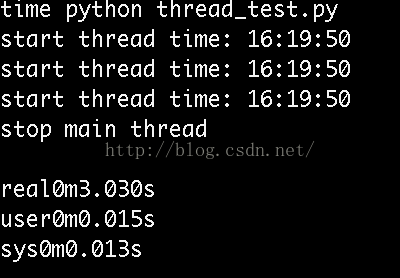
When executing the above program, you will find that after the main thread exits, the child threads are still executing, and the process ends after all the child threads are executed.
	threads.append(thread1)
	threads.append(thread2)
	for i in threads:
		i.join()
	print('Exit the main thread')
Insert join() after start to achieve thread synchronization, so that the main thread can enter the blocking state before the execution of the child thread is completed. After the execution of the child thread is completed, the main thread will continue to execute.
The output result becomes
Start thread Thread-1
Start thread Thread-2
…(sub-thread printing result)
Exit the main thread
Intelligent Recommendation
Use of thread join method
Reference blog: The first case (not using join): In this case, thread t1 and thread t2 compete fairly The second case (the role of join): Thread t1 and thread t2 make the original contention fair and ...
The role of python thread join
Few facts 1 python default parameters after the thread is created, regardless of whether the main thread is executed, will wait for the child thread to complete the execution before exiting, with or w...
python thread join
Test code...
Python thread join () function
First briefly introduce daemon thread: Work server daemon thread-like, as long as there is no request sent by the client, has been running and remains idle, much like the background. threading module ...
More Recommendation
Python thread Join and SetDaemon
Look at the setDaemon () method of the thread The above output is: We modify the code: The output of the program is: It can be seen that the setDaemon () method is to determine if the sub-thread is en...
Python Thread join() daemon()
join() Create a thread (thread name THREAD-1) using Thread, which performs the above TEST () function. IFname == ‘main': The following is the main thread, the main thread will continue to perfor...
Thread synchronization - synchronized modifier and join method
Multi-threaded calls can greatly improve the efficiency of the program, but the use of threads on the one hand will reduce readability and on the other hand bring randomness to the operation of the co...
Python multi -thread | Thread, use the Threading module to create a thread, thread synchronization, thread priority queue (Queue)
Multi -threading is similar to performing multiple different programs at the same time. Multi -threading has the following advantages: Using threads can put the tasks in the procedure for a long time ...
Java process and multithreading + join, yield, wait and other methods in thread + synchronized synchronization lock use
First understand what multithreading and processes are Process: It is an execution process, a dynamic concept --->Memory will be allocated Thread: a unit of the process, the thread is the smallest ...