Common GC garbage collection algorithms
tags: Technology Exchange Chuanzhi Podcast Xi'an Center
Common algorithms for garbage collection
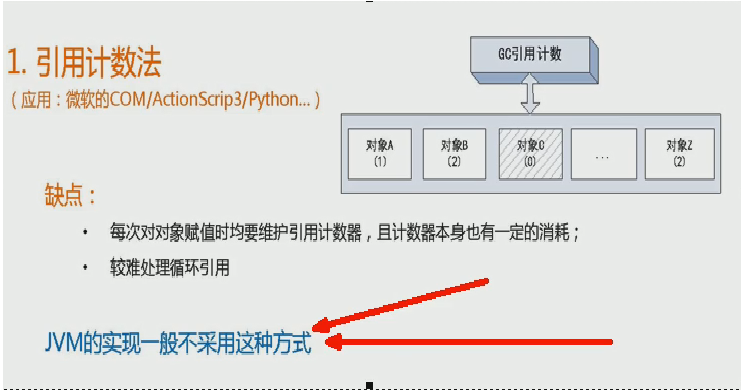
1. Reference counting method
1.1 Principle
1.2 Advantages and disadvantages
-
The real-time performance is high, and there is no need to wait until the memory is insufficient before starting to recycle. At runtime, it is judged whether the object counter is 0 and recycling is performed.
-
The application does not need to be suspended during the garbage collection process. If the memory is insufficient when applying for memory, an outofmember error will be reported immediately.
-
Regional, when updating the object counter, only the object will be impressed, not all objects will be scanned.
-
Every time an object is referenced, you need to update the object counter, which will increase the time overhead.
-
A waste of CPU resources, because the memory is enough, the object counter is still running statistics.
-
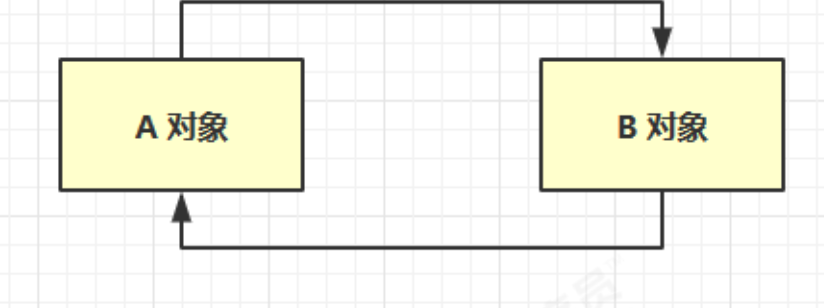
Unable to solve the circular reference problem (the biggest disadvantage)
2. Mark removal method
-
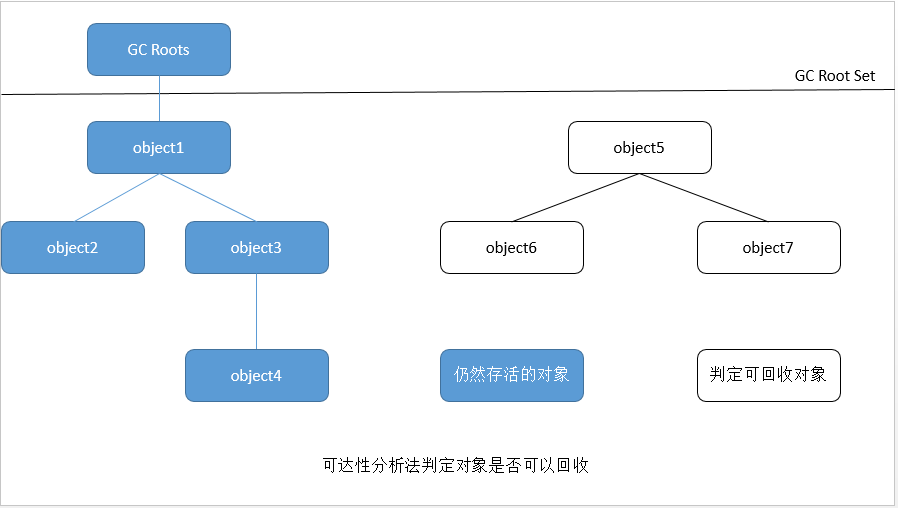
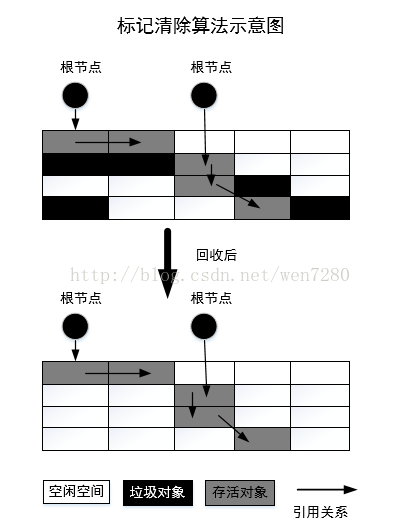
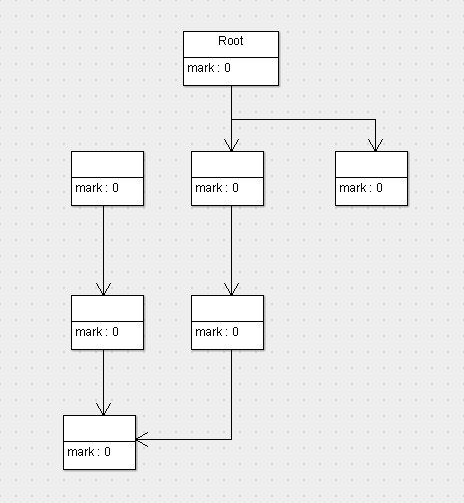
Mark: mark the referenced object starting from the following node
-
Cleanup: Objects that are not referenced by markup are garbage objects and can be cleaned up
2.1 Principle
2.2. Advantages and disadvantages
-
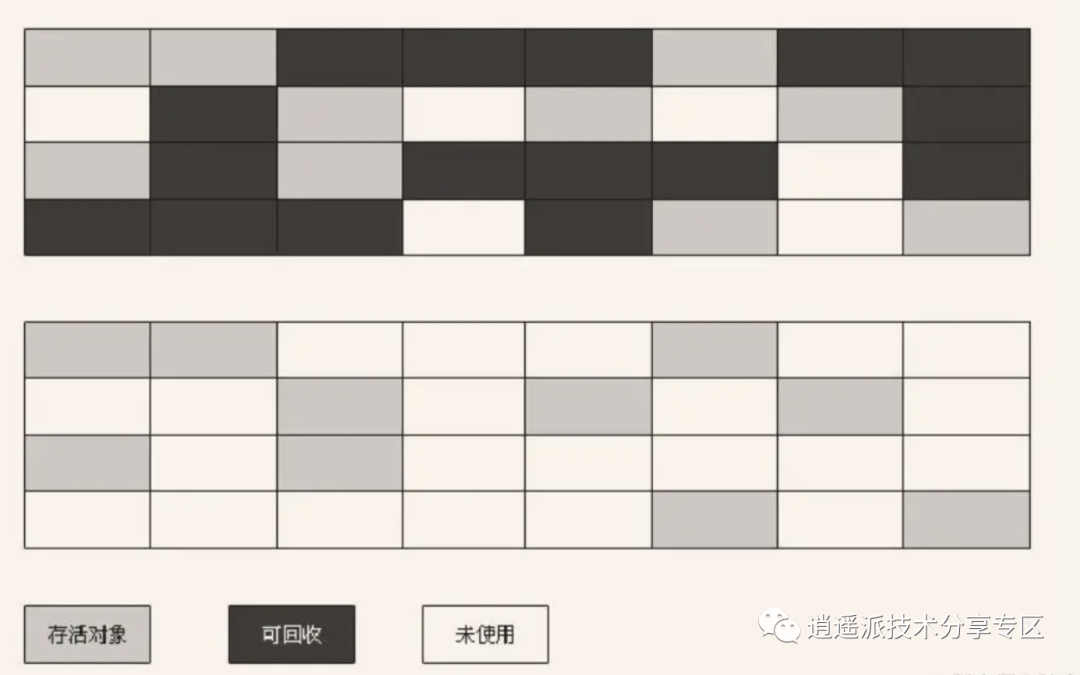
The efficiency is low. Both the marking and clearing actions need to traverse all objects, and the application needs to be suspended during the GC. This experience is very poor for applications with more interactive requirements.
-
Memory fragmentation cleaned up by the mark removal method is more serious, because the objects being cleaned exist in all corners of the memory, so the cleaned memory is not coherent.
3. Mark compression algorithm
3.1 Principle
3.2 Advantages and disadvantages
4. Copy algorithm
4.1. Young with memory space in JVM
-
At the beginning of the GC, the object will only exist in the Eden area and the Survivor area named "From", the Survivor area "To" is empty.
-
Immediately after the GC, all living objects in the Eden area will be copied to "To", while in the "From" area, the objects that are still alive will decide where to go based on their age value. Objects whose age reaches a certain value (the age threshold can be set by -XX: MaxTenuringThreshold) will be moved to the older generation, and objects that do not reach the threshold will be copied to the "To" area.
-
After this GC, the Eden and From areas have been emptied. At this time, "From" and "To" will exchange their roles, that is, the new "To" is the "From" before the last GC, and the new "From" is the "To" before the last GC. In any case, it will ensure that the Survivor area named To is empty.
-
The GC will repeat this process until the "To" area is filled. After the "To" area is filled, all objects will be moved to the old generation.
4.2. Advantages and disadvantages
-
In the case of many garbage objects, the efficiency is higher
-
No fragmentation of memory after cleaning
-
Not applicable in the case of few garbage objects, such as: old generation memory
-
The memory space is divided into two, only one of them is used, and the memory usage rate is low
5. Generational algorithm
Intelligent Recommendation
Garbage collection and several common garbage collection algorithms
Foreword: First think about the three things that Garbage Collection (GC) needs to accomplish 1) Which memory needs to be reclaimed? 2) When will it be collected? 3) How to recycle? In the ...

How to determine the object needs to be recycled in the garbage collection mechanism in Java? What are the common GC recycling algorithms?
Judging whether the object needs to be recycled: 1. Reference counting algorithm: Add one to the object (object head)Reference counter,When there is a place to reference it, the counter value adds one...
GC garbage collection algorithms and garbage collector (important, important, very important)
** sericl serial recovery (the recovery, other programs are suspended) Parallel Parallel recovery (to find a plurality of cleaning work, other program has paused) CMS concurrent recovery tag (4 steps,...
How does GC determine garbage? and garbage collection algorithms
1. What is garbage? The object takes up memory resources, but you can never use the object. The general case is that there is no referenced object or an object that does not perform external reference...
JVM--Garbage Collection--Common Algorithms
table of Contents Common garbage collection algorithms 1. Reference counting 2. Mark removal method 3. Marker compression algorithm 4. Copy Algorithm Generational algorithm Common garbage collection a...
More Recommendation
Common garbage collection algorithms of JVM
Algorithm 1:Reference counting method. This method is the most classic method. Specifically, a reference counter is set for the object. Every time a variable references to it, the reference counter wi...
JVM common garbage collection algorithms
In the Java memory model, the program counter, virtual machine stack, and local method stack are independently owned by each thread and "live and die" with the thread. The memory size of eac...
Several common garbage collection algorithms
Common garbage collection algorithms include: mark-sweep algorithm copy algorithm Mark-Collating Algorithm Generational Collection Algorithm The JVM's garbage collection algorithm uses a generational ...

Common garbage collection algorithms and classic garbage collectors
Common garbage collection algorithms and classic garbage collectors How to identify garbage Reference counter Accessibility analysis Common garbage collection algorithms in JAVA Mark removal algorithm...
JVM optimization 2: What is garbage collection, common algorithms, garbage collectors, memory allocation, and visual GC log analysis tools
JVM optimization-2 Today's content Understand what garbage collection is Master the common algorithms for garbage collection Learn serial, parallel, concurrent, G1 garbage collector Learn to visualize...